2009 SONA word cloud

Here’s a word cloud of the 2009 State of the Nation Address. Common prepositions and function words were omitted in creating this cloud.

2009 SONA Word Cloud

To be fair, the president used “inclusive” pronouns such as “we,” “our” and “atin” quite a lot. But she used an alarming number of instances of “I” as well.

So is it really about the State of the Nation or the State of Gloria’s Presidency?

Sonananaman

Tomorrow, Gloria Arroyo will once again deliver her State of the Nation Address. What’s in store for her audience remains to be heard but as always, we can always expect it to be one heck of a day.

Classes have been suspended at all levels but only a few students will be listening with a critical ear. Most of the working population will go about their routines. Some will hear it, some will not. Personally, my TV’s busted to I’ll have to rely on the Internet for updates.

Commonwealth Avenue will again be a circus with usual clash of riot police and militant activists. It has always been a great spectacle but tomorrow, Iglesia ni Kristo will also be celebrating their anniversary so we can all expect the expansive stretch of concrete to be awash with more color.

Unless Arroyo has some big announcement (snap elections, Martial Law, or Con Ass), I can only expect it to be more of the same – a speech from president trying to quantify her successes through numbers and qualify them with anecdotes. Some would say, the real SONA is on the streets – the cold hard facts of life compared to the more than optimistic view of an unpopular president.

Well, I say the true state of the nation is in every Filipino. Your nation is only as good as how your life in it is.

UPDATES:
1. Word Cloud
2. Full Text via Tonyo Cruz

Reviving Sugoi Stuff

My first attempt at “pro” blogging (as in trying to make money with blogging) isn’t with this website or with Bloggy Network. It’s with this blog – Sugoi Stuff. It was December of 2006 when I proposed the idea to a couple of friends of mine from back in college. Being the anime heads that we were, we decided on putting up a Philippines-Japan blogzine.

Sugoi Stuff

As with many virginal attempts, it had been quite the disappointment. We started with much vigor, even sponsoring a couple of events, but eventually, real work got in the way and Stugoi Stuff took the back seat. There were a couple of attempts to finally get it back on track but it proved to be tough to squeeze in posting on the blog when all of us needed to do work that actually pays.

(more…)

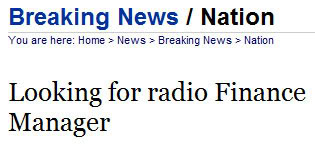
Breaking ads or classified news?

Inquirer Breaking News Classified Ads

When did they begin considering classified ads as breaking news? So this is of national importance?

Quick! A finance management position needs to be filled! The nation’s economy will collapse if this doesn’t get filled!

It would’ve been a lot more interesting if its an ad for an honest politician.

Flouters

Had quite an interesting discussion regarding Gricean pragmatics this morning and had me thinking about . It’s funny how all of these theories and books can be filtered down and summarized to just a few of their core sections. With H.P. Grice, many linguistics majors just remember him with his Co-operative Principle.

In a nutshell, the idea goes that to achieve mutual understanding in a conversation, communicators often follow abide by four maxims and these are:

  • Quantity – be informative
  • Quality – be truthful
  • Relation – be relevant
  • Manner – be clear and concise

The thing is, reality has it that even by flouting (breaking) these maxims, we are able to achieve creating all sorts of meaning and to some extent a mutual understanding because of our ability to interpret conversational implicatures. Sarcasm for example (though we have to admit that not all people are “sensitive” enough to interpret this).

As far as online discourse go, many constantly flout most if not all of these maxims (some all at once). Take social media and blogging for example. How much information do we convey to our audience? How truthful are we? How relevant is our message? How clear and concise are these messages? Survey the statuses of friends on Facebook or people’s tweets and you’d struggle to make sense of most of them. And still, the Web thrives with our discourses.

Sure there are quite a lot of cases of misunderstanding because of varying interpretations but we just have to deal with understanding’s evil twin.